
Chanel F/W Haute Couture '15
[av_textblock size='' font_color='' color='']
In honor of the Chanel Métiers d'Art show unveiling in Salzburg, Austria (my absolutely enchanting hometown...!!) in exactly 3 weeks, I've decided to write a review on their previous Fall/Winter 2015 Haute Couture Collection, which debuted July in Paris, because well, I'm just too, gobsmacking excited to see what will be presented on December 2!
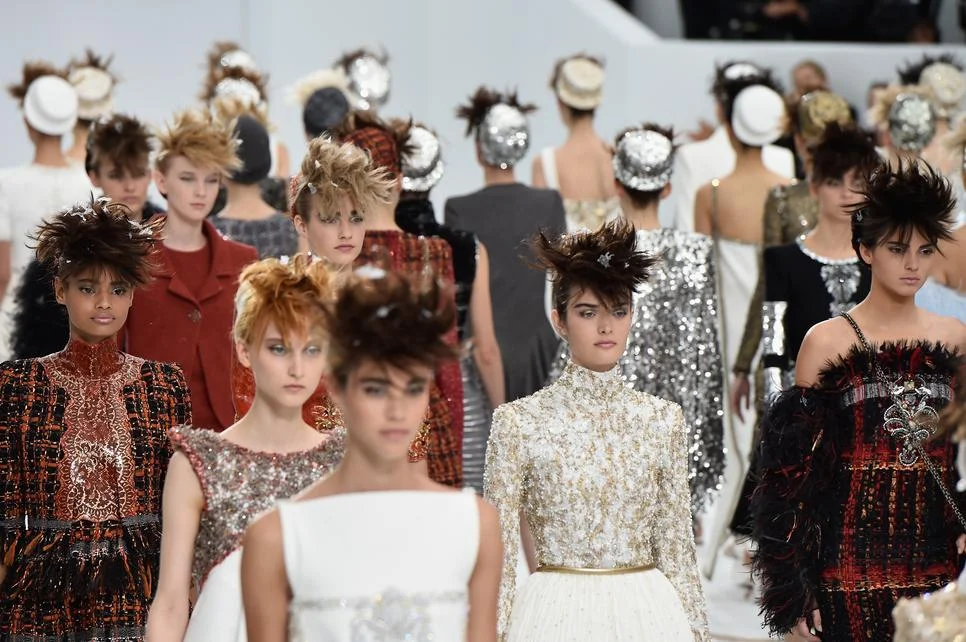
Perhaps the best way to describe the Chanel, or shall I say Lagerfeld, spectacle would be a baroque urbanization. Drawn from inspiration of the Roi Solei and the less flamboyant, yet equally iconic Le Corbusier, Lagerfeld composed a unique look fitting a 21st century, through pioneering material and gallant silhouettes. New, modern, and fresh, yet traditional and complex are words that immediately jump to mind.
The setting of the Parisian Grand Palais oozed intimacy, due to a quaint, select audience, bringing back haute couture prestige from previous overly commercialized buzz. White were the walls and runway, overlooked by a beautiful baroque gilded mirror and a Bill Viola-esque fireplace parked at the end of the room; a setting filled with both hypermodernity and 17th century heritage. Such a crisp atmosphere reflected and engulfed the 70 looks of Chanel, like sunrays in the snow.

The theme of architecture was blatant, with a compromise between Versailles and Villa Savoye. Both buildings opposite in style, but iconic in their own right. They fulfill a purpose of representing mentalities and extravagance of their eras, which is accurately translated into “ready to wear” couture. Le Corbusier elements are incorporated through the flawless shaping and tailoring of jackets, skirts, and dresses, which reminds one of a Notre Dame du Haut with its oblong ceiling. The various geometric lines further emphasizes mid 20th century architecture, which connote to a façade of logical efficiency, sophistication, and power. The combination of such shaping and mathematic influences lead to unique 21st century tailoring, where we have a breakthrough of a new socially acceptable silhouette.


Le Corbusier is also apparent throughout the choice of revolutionary materials, such as concrete. Not only was concrete incorporated into jewelry, but also on dress elements, which gave the impression of a modern mosaic of a bird’s eye view of an urban jungle. Also various textile choices portrayed black and gold marble, which crossed over to a more Baroque architecture.
Responsible for tying such Baroque elements with Le Corbusier just happens to be Gabrielle’s legacy: tweed. A tweed dress is paired with a mid waist jacket, with bicycle shorts underneath, hemmed just above the knee. Not only does the print remind me of a building with urban windows, but also of a 17th century male of the French Royal court, with his many layers, including hose and cuff. Such intertwined reminders of Louis Quatorze along with the blunt spirit of a Unite d Habitation, Lagerfeld seems to be crossing boundaries and questioning social hierarchy and if such a plain, concrete lifestyle can generate as much inspiration and beauty as the pompousness of Versailles? Yes.


With the high heel eliminated (our feet are spared, yet another season :D!), sandals are tied with ribbon to compliment each outfit, with Lagerfeld clarifying: “ [Now] they can move, they can jump; what they [could not] do in stilettos.” Moreover, it is pointed out, one doesn’t walk as heavy as in high heels, and models sweep across the Palais like soft breaths of fresh air. I compare them to bird like creatures, with their elongated necks and spiky, feather like updo. Undone, flowing hair wouldn’t have suited and would take attention away from the intricate detail of each costume, detail such as the subtle rococo stucco references, which once again emphasized Lagerfeld’s immense knowledge of art and history.

 Along with the fireplace, the collection’s pallet was filled with flames; burning reds and ash grays, pulsing with drama and heat. It was an absolute quench when the full length chiffon cyan gown with whimsical feathers trickled down the runway.

However, the climax of the collection was the (at the time) seven month pregnant Ashleigh Good. Her presence was like a Madonna, a goddess, a queen straight out of a Van Eyck painting. Not only was the white and gold gown enough to summon a fanfare, but also it was a triumph to witness a new body shape in haute couture!

Have we reached a gateway in accepting new shapes and sizes to the runway (both in terms of silhouettes and of models)? If anyone can make it happen, it is Karl. We have been spoiled by his genius yet again, and are on the verge of a century of new shape; a century which hasn’t forgotten its roots, but flies like a phoenix out of the ash to an exciting future.
I look forward to seeing what Mr. Lagerfeld has in store for us in Salzburg!
[/av_textblock]
